
Continuous Improvement, Anchored to Patient Safety

At SCA Pharmaceuticals, quality is engineered into our processes, demonstrated in our data, and verified in our products. From a customer’s request for a new product through the release of finished goods, an integrated set of quality standards governs every decision. We pursue continuous improvement deliberately — through process improvement, variability reduction, innovation, and ongoing enhancement of our Pharmaceutical Quality System — because the patients we ultimately serve depend on our willingness to never accept “good enough.”
Quality in People
Our people are the foundation of our Quality system. SCA Pharmaceuticals invests in a structured recruitment process that identifies individuals with the technical capability and personal accountability that sterile compounding demands. Every employee receives role-specific training, ongoing competency assessment, and the procedural and physical tools needed to perform at standard. Training is documented, verified, and continuously refreshed through our electronic Quality Management System.
Quality in Facilities and Aseptic Process Validation
Our facilities are designed to FDA expectations for cGMP sterile compounding. Cleanrooms, supporting utilities, and process equipment are robustly qualified at installation, requalified on a defined cadence, and continuously monitored during operation. Aseptic process performance is verified through a formal Aseptic Process Simulation (media fill) program that mirrors the worst-case conditions of routine production, including operator interventions, batch duration, and fill volume. Customer audits are welcomed; transparency to our partners is a feature of our system, not an exception to it.
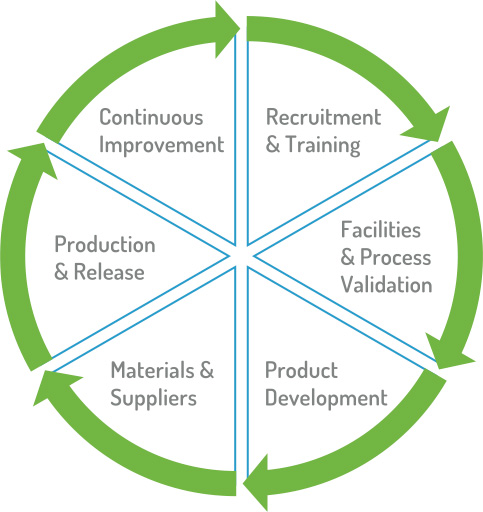
Quality in Product Development and Lifecycle Management
New product introduction at SCA Pharmaceuticals is governed by a formal intake and development process that evaluates each candidate against scientific, regulatory, and operational acceptance criteria. Stability programs are executed under ICH-aligned conditions to establish a defensible BUD, container-closure compatibility is verified, and labeling is reviewed against all applicable standards. Once commercialized, every product remains under ongoing process performance monitoring through the lifecycle.
Quality in Materials and Suppliers
Quality begins at the supply chain. Active pharmaceutical ingredients, excipients, primary packaging components, and critical consumables are sourced from suppliers qualified through a formal Supplier Management program that includes audits, material risk assessments, and ongoing performance review. All materials meet the current edition of the relevant pharmacopeia and are manufactured in cGMP-compliant facilities. Supplier performance is continuously trended, and supplier-attributable findings are managed through the same Corrective and Preventive Action system that governs internal events.
Quality in Production and Release
Compounding operations are conducted under the direct supervision of licensed pharmacists who verify critical compounding steps for every batch. Finished products are quarantined until every release test has completed and every supporting record has been independently reviewed. The independent Quality Unit alone dispositions batches — and only after the complete batch record, environmental data, and analytical and microbiological test results have been independently evaluated against pre-defined acceptance criteria.
- Every product lot undergoes sterility testing using the growth-based Celsis® rapid detection system, validated as an alternative microbiological method under USP <1223> with demonstrated comparability to the compendial USP <71> test. The growth-based methodology protects the regulatory rigor of compendial testing while preserving usable shelf life for the patients who need every available day of BUD.
- Bacterial Endotoxins. Every lot is tested for bacterial endotoxin per USP <85>. Our endotoxin testing platform is fully validated and operated under cGMP.
- Potency / Assay. Every lot is released against a defined potency specification using a validated, stability-indicating analytical method.
- Visible Particulates and Container-Closure Integrity. Every unit is inspected against defined acceptance criteria for visible particulates and container-closure performance.
- Environmental Monitoring. Comprehensive viable and non-viable environmental monitoring is performed during every compounding session in accordance with USP <1116> and cGMP requirements. Personnel monitoring is performed at defined frequencies. Finished product remains in quarantine until environmental and personnel monitoring data are reviewed against acceptance criteria.
- Independent Quality Release. A Certificate of Conformance is generated and signed by the our Quality Assurance team for every batch. The C of C documents the executed test methods, the corresponding specifications, and the actual results. It is available to our customers as definitive documentation of conformance to 503b testing requirements.
Contamination Control Strategy
A formal, facility-level Contamination Control Strategy underpins our sterile compounding operations. The CCS integrates facility design, equipment qualification, personnel behavior, environmental and personnel monitoring, disinfection and sanitization, gowning, material flow, process simulation, and ongoing data review into a single coherent risk-control framework. It is reviewed and updated as facilities, processes, and regulatory expectations evolve — and as data from monitoring programs informs continuous improvement.
Quality Risk Management
Risk-based decision making is embedded throughout our Quality system. We apply ICH Q9(R1) principles to facility and equipment qualification, process design, change control, deviation investigation, and product disposition decisions. Risk assessments are documented, technically rigorous, and revisited when underlying conditions change.
Data Integrity
The integrity of the data on which we release product is non-negotiable. SCA Pharmaceuticals applies ALCOA+ data integrity principles — Attributable, Legible, Contemporaneous, Original, Accurate, Complete, Consistent, Enduring, and Available — to every laboratory result, batch record, and quality system record. Our electronic systems are validated, our paper systems are controlled, and our governance is auditable.
A Proactive Continuous Improvement Function
SCA Pharmaceuticals has established a dedicated Continuous Improvement team within the Quality organization whose mandate is proactive — not reactive. The team works upstream of deviations and audit findings to identify opportunities to strengthen processes, reduce variability, simplify systems, and enhance the patient safety margin embedded in our operations. It engages directly with manufacturing, technical services, microbiology, and chemistry to translate data, observation, and operator insight into structured improvement initiatives that are tracked through completion and verified for effectiveness.
Continuous improvement metrics are reported at the facility and enterprise levels, reviewed by senior leadership at Management Review, and translated into prioritized initiatives. We actively solicit and act on customer feedback as an essential input to that program.